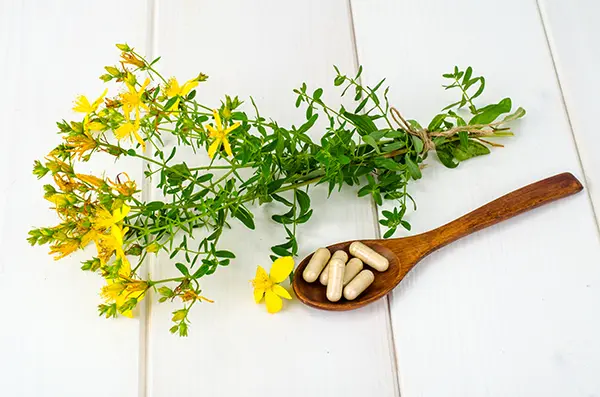
St. John’s wort (Hypericum perforatum) is one of the oldest and most investigated herbs used; it is a perennial with abundant yellow flowers, best known for its antidepressant, anxiolytic, antiviral, antibacterial, antiinflammatory, and analgesic properties.[1] St. John’s wort is so named because it flowers in the midsummer, around St. John’s-the-Baptist’s Day on June 24.[2] It grows widely in Europe and North America. Earliest reports of medicinal use of this herb date from the early Greeks and Romans in the first century CE, as well as later on by Paracelsus around 1500 CE.[2] In modern times, St. John’s wort has been extensively studied for its antidepressant effects.
Action
St. John’s wort has been shown to contain several classes of chemical constituents, including naphthodianthrones, xanthones, flavonoids, phloroglucinols (e.g. hyperforin), and hypericin.[3] Of these, hyperforin and hypericin are thought to be mostly responsible for its medicinal effects.[1]
The precise mechanism of action of St. John’s wort in mood regulation is not well understood, but studies have shown that St. John’s wort may interact with various neurotransmitter (i.e. signaling) systems in the brain. Vance et al describe this as follows: “St. John’s wort extract has been postulated to inhibit the neuronal uptake of neurotransmitters such as serotonin, norepinephrine, dopamine, gamma-aminobutyric acid (GABA), and l-glutamate, alter noradrenergic and serotonergic receptor expression, and inhibit monoamine oxidase enzymatic activity. […] Hyperforin is believed to activate the nonselective cation transient receptor potential (TRP) channel TRPC6 to increase intracellular sodium and calcium content, therefore reducing neurotransmitter reuptake.”[4]
Evidence
Several meta-analyses of clinical trials have shown that St. John’s wort is effective in treating mild to moderate depression.[5][6][7] A meta-analysis of 35 randomized controlled trials examining 6993 patients found that St. John’s wort was associated with more treatment responders compared to placebo, and that subjects taking St. John’s wort were less likely to experience adverse events, with no difference in treatment effectiveness in mild and moderate depression.[5] Patients who received St. John’s wort experienced fewer adverse effects of the gastrointestinal and neurological body systems, and fewer adverse effects affecting sexual function and psychiatric function.
A Cochrane review evaluated data from 29 randomized controlled trials including 5489 patients; 18 studies compared St. John’s wort with placebo and 17 compared with synthetic standard antidepressants.[6]
The analysis concluded that St. John’s wort extracts are:
- superior to placebo in patients with major depression;
- similar in effectiveness as standard antidepressants; and
- have fewer side effects than standard antidepressants [6](participants were less likely to drop out of studies due to side effects, suggesting a considerable difference in the tolerability of treatment).
Given that Cochrane is generally quite conservative in its conclusions regarding the treatments reviewed, these results are noteworthy to be sure.
Additional Effects
In addition to mood-regulating effects, St. John’s wort and its compounds have demonstrated a range of intriguing activities, including antiinflammatory effects, neurological effects, and even possibly anticancer effects:
- Inhibition of inflammation through inhibition of janus kinase 1 enzyme (hypericin);[8]
- Reduction of inflammation by decreasing TNF-α (which activated NF-κB pathway) in patients with psoriasis, and reducing psoriasis plaques (topical application);[9]
- Modulatation of brain cortical plasticity in humans (Hypericum extract WS® 5570);[10]
- Induction of apoptosis in non–small-cell lung cancer cell lines, associated with activation of the p38 MAPK and JNK induced mitochondrial death pathway (hyperoside).[11]
Traditionally, St. John’s wort has also been used topically for its antiinflammatory, antibacterial, and analgesic effects for various kinds of external wounds and traumas.[12] St. John’s wort is traditionally used internally for urinary tract infections, digestive infections such as infectious diarrhea, as well as injuries of the nervous system including concussions.[12]
Drug Interactions
St. John’s wort may interact with a number of medications, including selective serotonin reuptake inhibitors (SSRIs) and other antidepressants, cardiovascular medications such as warfarin and digoxin, oral contraceptives, anticonvulsants, triptans, immunosuppressants such as cyclosporin, theophylline, HIV protease inhibitors, and anticancer agents.[13][14] The hyperforin content in St. John’s wort is thought to be responsible for these interactions through induction of the CYPP450 enzymes and p-glycoprotein drug efflux pump.[14]
 Conclusion
St. John’s wort is an herb with a long history of use and good depth of scientific research. It has been shown to be effective for mild to moderate depression. Evidence suggests its effectiveness is similar to that of pharmaceutical antidepressants. Additional effects include antiviral and antibacterial effects, antiinflammatory effects, and possible effects on cognition. Due to potential interactions with many medications, individuals should consult a licensed health-care practitioner prior to use, in order to determine whether St. John’s wort is an appropriate treatment strategy for them.
References
- Galeotti, N. “Hypericum perforatum (St John’s wort) beyond depression: A therapeutic perspective for pain conditions.” Journal of ethnopharmacology Vol. 200 (2017): 136–146.
- Pöldinger, W. “[History of St. Johns wort].” [article in German] Praxis, Vol. 89, No. 50 (2000): 2102–2109.
- Russo, E., et al. “Hypericum perforatum: Pharmacokinetic, mechanism of action, tolerability, and clinical drug-drug interactions.” Phytotherapy research, Vol. 28, No. 5 (2014): 643–655.
- Vance, K.M., et al. “St. John’s Wort enhances the synaptic activity of the nucleus of the solitary tract.” Nutrition, Vol. 30, No. 7–8 Suppl. (2014): S37–S42.
- Apaydin, E.A., et al. “A systematic review of St. John’s wort for major depressive disorder.” Systematic reviews, Vol. 5, No. 1 (2016): 148.
- Linde, K., M.M. Berner, and L. Kriston. “St John’s wort for major depression.” The Cochrane database of systematic reviews, No. 4 (2008): CD000448.
- Ng, Q.X., N. Venkatanarayanan, and C.Y. Ho. “Clinical use of Hypericum perforatum (St John’s wort) in depression: A meta-analysis.” Journal of affective disorders, Vol. 210 (2017): 211–221.
- Dellafiora, L., et al. “On the mechanism of action of anti-inflammatory activity of hypericin: An in silico study pointing to the relevance of janus kinases inhibition.” Molecules, Vol. 23, No. 12 (2018). pii: E3058.
- Mansouri, P., et al. “The impact of topical Saint John’s Wort (Hypericum perforatum) treatment on tissue tumor necrosis factor-alpha levels in plaque-type psoriasis: A pilot study.” Journal of postgraduate medicine, Vol. 63, No. 4 (2017): 215–220.
- Concerto, C., et al. “Hypericum perforatum extract modulates cortical plasticity in humans.” Psychopharmacology, Vol. 235, No. 1 (2018): 145–153.
- Yang, Y., et al. “Effect of hyperoside on the apoptosis of A549 human non-small cell lung cancer cells and the underlying mechanism.” Molecular medicine reports, Vol. 16, No. 5 (2017): 6483–6488.
- Henriette’s herbal homepage. “Hypericum.—St. John’s wort.” King’s American Dispensatory, 1898. · https://www.henriettes-herb.com/eclectic/kings/hypericum.html · Accessed 2019-01-30.
- Barnes, J., L.A. Anderson, and J.D. Phillipson. “St John’s wort (Hypericum perforatum L.): A review of its chemistry, pharmacology and clinical properties.” The Journal of pharmacy and pharmacology, Vol. 53, No. 5 (2001): 583–600.
- Soleymani, S., et al. “Clinical risks of St John’s Wort (Hypericum perforatum) co-administration.” Expert opinion on drug metabolism & toxicology, Vol. 13, No. 10 (2017): 1047–1062.

 English